
Private Jet Charter Miami to Denver
Private jet charter Miami to Denver covers 1,479 nautical miles. A midsize jet flies it nonstop in 3h 50m for an estimated $20,000-$30,000. We compare classes, airports, and timing so you can choose with clear numbers.
- 1,479 nm1,702 miles (statute)
- 3h 50mmidsize jet time aloft
- $20,000–$30,000one-way estimate
Miami to Denver private jet costs by aircraft
Going by private jet from Miami to Denver takes 3h 50m over 1,479 nautical miles on a midsize jet, with a one-way estimate of $20,000–$30,000.The chart below compares five aircraft classes on this route. Turboprops and light jets require a fuel stop; midsize and larger fly nonstop. Prices are estimates for the whole aircraft, not per seat. Times assume typical winds and a direct routing.
| Aircraft class | Flight time | One-way ballpark | Notes |
|---|---|---|---|
| Turboprop | 6h 14m | $13,500–$22,000 | Fuel stop expected |
| Light jet | 4h 40m | $17,500–$27,000 | Fuel stop expected |
| Midsize jet | 3h 50m | $20,000–$30,000 | Top match |
| Super-midsize jet | 3h 36m | $26,000–$36,000 | Nonstop |
| Heavy jet | 3h 36m | $34,000–$52,500 | Nonstop |
Figures are per aircraft, not per passenger, prior to federal excise tax and segment fees. Duration covers taxi, climb and descent.
Why a midsize jet fits this trip
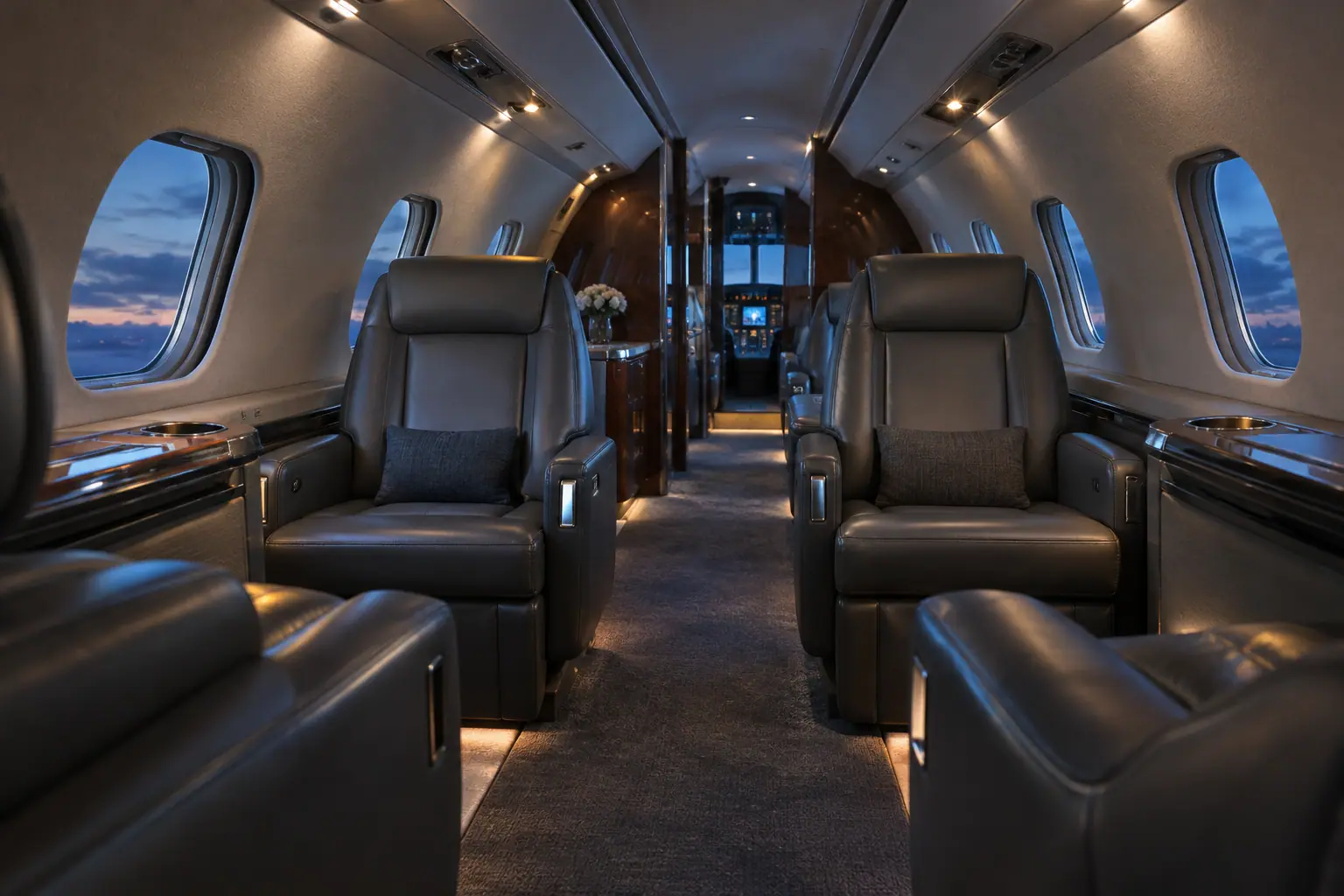
A midsize jet is the first class on this route that flies nonstop with full tanks and eight passengers, and the Citation XLS+ and Hawker 800XP both have the range for 1,479 nautical miles. The XLS+ carries eight in a cabin 5 ft 8 in tall with 90 cu ft of baggage; the Hawker 800XP matches the passenger count and adds a taller cabin at 5 ft 9 in. If your party is four or fewer and you do not mind a fuel stop, a light jet saves several thousand dollars. If you want stand-up headroom or a flat floor for work, a super-midsize or heavy jet cuts the time only slightly but improves comfort over 3h 36m in the air.
A midsize jet can fly Miami to Denver nonstop and still have reserves to continue, which keeps same-day round trips viable. A light jet would need to stop for fuel, adding time on both legs. For groups of six to eight with ski or golf bags, the midsize baggage holds and nonstop range make it the practical default. The heavy jet becomes worth the premium when you need a bed or a larger cabin for eight adults, or the ability to depart at short notice when midsize aircraft are booked.
Hawker 800XP
- 8 seats
- 447 kt speed
- 2,540 nm legs
Cabin 5 ft 9 in tall, 21 ft 4 in long. Bags 50 cu ft.
Cessna Citation XLS+
- 8 seats
- 441 kt speed
- 2,100 nm legs
Cabin 5 ft 8 in tall, 18 ft 6 in long. Bags 90 cu ft.

Departing Miami
Miami-Opa Locka Executive (KOPF) is the usual departure point for charter flights, with an 8,002 ft runway and less terminal congestion than Miami International (KMIA), which has a 13,016 ft runway. Your operator will confirm the FBO and the ramp. If you are flying internationally before this leg, CBP clearance is handled at the arrival airport, but for a domestic Miami to Denver flight, no customs stop is needed.
Plan to arrive 15 to 20 minutes before departure for a domestic flight. The crew will load bags, brief you on the cabin, and confirm the routing. In summer, afternoon thunderstorms are common across Florida, so earlier departures reduce the chance of a ground hold. The operator holds operational control and makes the go/no-go call on every flight, so build in a buffer if your schedule is tight.
Arriving in Denver
Denver has four airports used by charter aircraft: Centennial (KAPA) with a 10,001 ft runway, Rocky Mountain Metropolitan (KBJC) with 9,000 ft, Buckley Space Force Base (KBKF) with 11,006 ft, and Denver International (KDEN) with a 16,000 ft runway. Centennial is the most common choice for business and ski traffic because it sits close to the tech corridor and I-25. Rocky Mountain Metropolitan serves the Boulder and northwest suburbs. Buckley is a military field with limited civilian access, so confirm availability before scheduling.
Summer density altitude matters in Denver. On a hot afternoon, the thinner air lengthens takeoff rolls, and a heavy jet departing fully fueled may need a longer runway or a weight restriction. Your operator will compute performance for the actual temperature and runway. If your schedule allows, a morning departure from Miami and a mid-day arrival avoids the worst heat and the afternoon storm window.
| Airport | Code | Runway |
|---|---|---|
| Miami-Opa Locka Executive Airport | KOPF / OPF | 8,002 ft |
| Miami International Airport | KMIA / MIA | 13,016 ft |
| Buckley Space Force Base | KBKF / BFK | 11,006 ft |
| Rocky Mountain Metropolitan Airport | KBJC / BJC | 9,000 ft |
| Centennial Airport | KAPA / APA | 10,001 ft |
| Denver International Airport | KDEN / DEN | 16,000 ft |
When demand and prices peak
Demand peaks on this route around major ski weekends and holidays from December through March, when South Florida travelers head to the Colorado mountains, and again in late summer. If your dates fall on a Friday or Sunday during ski season, book two to three weeks ahead to hold a midsize aircraft at a normal rate. The return direction, Denver to Miami, also tightens when conventions or events fill both cities.
Rates rise when you book inside seven days, and same-day requests may require an empty leg or a larger aircraft than you need. Ask your broker to quote a few departure windows rather than a single time, because a morning departure can price differently from an afternoon one due to aircraft repositioning. Also ask about the return leg at the same time. A round trip booked together often prices better than two one-way charters because the operator avoids an empty return.
Private jet routes similar to Miami to Denver
Each of these 6 private jet legs runs 893 to 1,514 nautical miles, with one-way midsize jet estimates from $12,500 to $30,500.

Questions about this route
How much does private jet charter Miami to Denver cost?
A midsize jet, the recommended class, runs an estimated $20,000 to $30,000 for the whole aircraft. A light jet is $17,500 to $27,000 but needs a fuel stop. A super-midsize is $26,000 to $36,000, and a heavy jet is $34,000 to $52,500. These are estimates, not quotes; the operator confirms the final price based on aircraft, date, and passenger count.
How long is the flight from Miami to Denver by private jet?
A midsize jet flies nonstop in about 3 hours 50 minutes for the 1,479 nautical mile route. A super-midsize or heavy jet takes about 3 hours 36 minutes. Light jets and turboprops require a fuel stop, which pushes the trip to 4 hours 40 minutes or more. Winds aloft can shift these times by 15 to 25 minutes on either end.
Can a light jet fly nonstop from Miami to Denver?
No. At 1,479 nautical miles, the route is beyond the practical range of most light jets with passengers and bags, so a fuel stop is required. That adds roughly 40 to 60 minutes on the ground. If a nonstop is important, choose a midsize or larger aircraft. The Citation XLS+ and Hawker 800XP both cover the distance nonstop.
Which Denver airport will my charter use?
Centennial (KAPA) is the most common for business travel, with a 10,001 ft runway. Rocky Mountain Metropolitan (KBJC) suits the Boulder area with a 9,000 ft runway. Denver International (KDEN) has a 16,000 ft runway and handles larger aircraft. Buckley Space Force Base has an 11,006 ft runway but limited civilian access, so check with your operator first.
How far ahead should I book a private jet charter Miami to Denver?
Book two to three weeks ahead for ski season weekends from December through March, and for holiday periods. Inside seven days, rates typically rise and midsize availability narrows. For same-day or next-day travel, expect the broker to look at empty legs or a larger aircraft. A round trip booked as one trip often prices better than two separate one-ways.
Who operates the aircraft on a private jet charter Miami to Denver?
The aircraft is flown by an operator holding FAA Part 135 certification, which sets crew duty, maintenance, and training rules. The operator holds operational control of the flight. A broker arranges the trip and, under DOT Part 295 rules, acts as an agent for the operator. Your contract and safety record should name the operator directly. Ask for that information before you book.