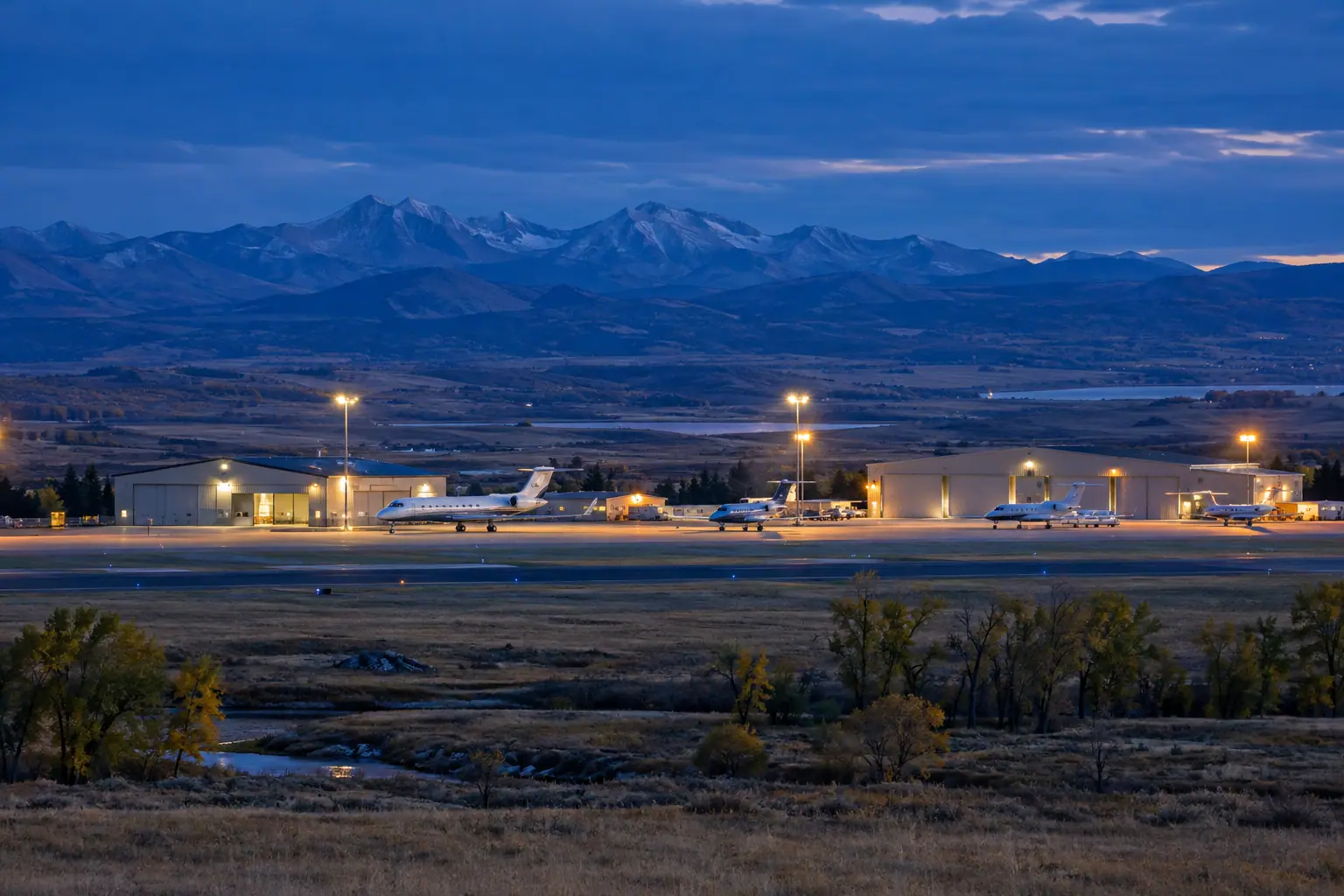
Private jet charter Rocky Mountain Metropolitan
Private jet charter Rocky Mountain Metropolitan puts you on Denver's north side. The field sits at 5,673 feet with a 9,000-foot main runway. Summer afternoons change the math, so plan the departure hour with care.
- KBJC · BJCairport codes
- 5,673 ftairport elevation
- 9,000 ftmax strip length
- 14 mito Downtown Denver
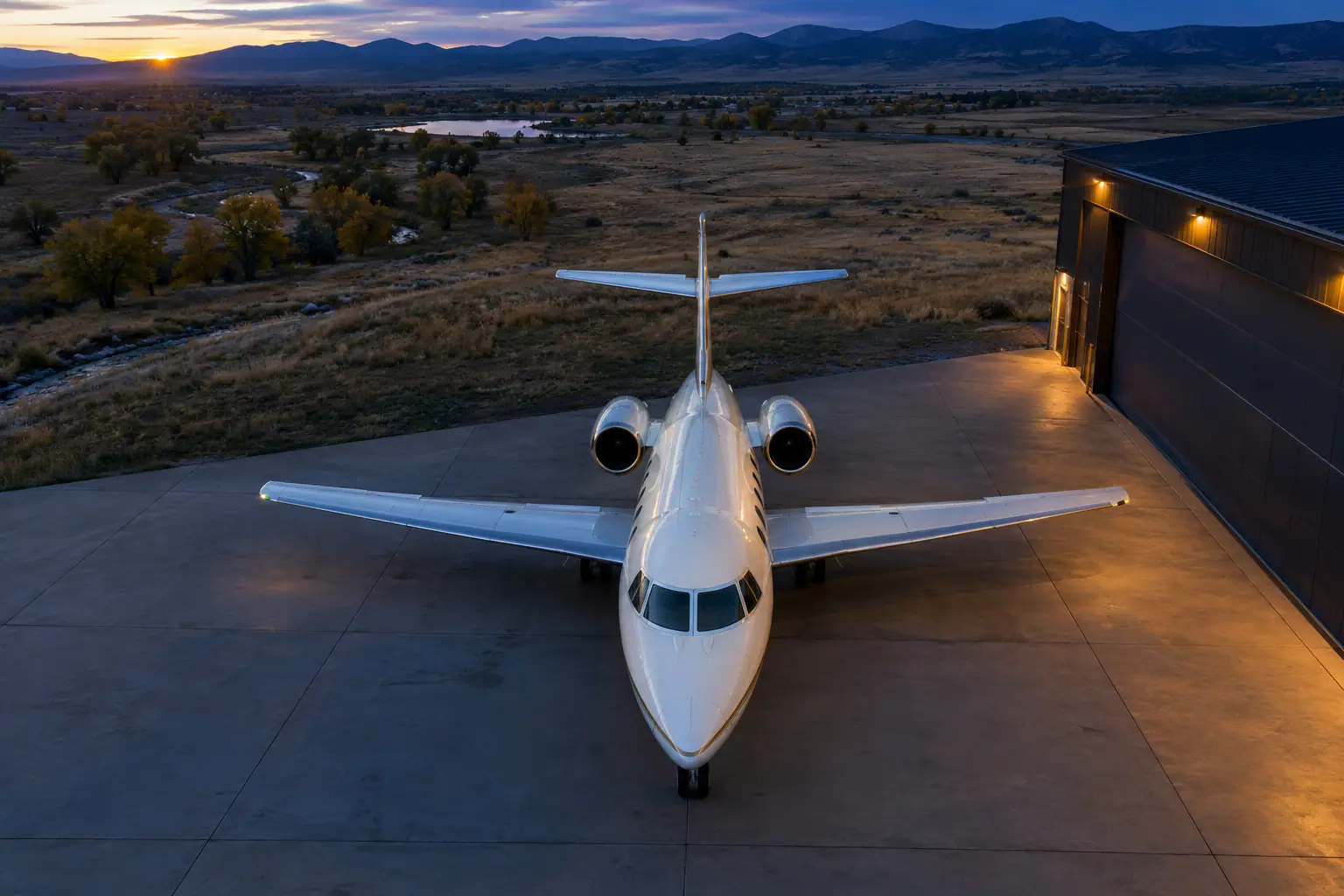
Private jet charter Rocky Mountain Metropolitan is a broker-arranged service, which means we match your trip to an operator whose aircraft and crew fit the runway and the season. The airport itself is the former Jeffco field, a general aviation hub northwest of the city between Broomfield and Westminster. Rocky Mountain Metropolitan private jet departures run under FAA Part 135 operators who hold operational control of every flight, while we act as your agent under DOT Part 295. It handles light and midsize jets with ease and takes larger cabins on the long strip.
Elevation is the first thing a broker checks here, not the price list. At 5,673 feet the air is already thin before summer heat arrives, and a July afternoon can push density altitude toward 9,000 feet. Summer afternoons at Rocky Mountain Metropolitan test performance margins, so early morning departures protect your range, and we will tell you plainly when a schedule change saves a stop. That thins margins on hot, heavy days, so a departure at 8 a.m. often allows a fuller fuel load and a longer nonstop leg than the same jet at 3 p.m. If your group is large or the bags are heavy, then we may suggest a bigger cabin or a different field rather than trim fuel.
For a ski trip to Summit County or a Vail Valley weekend, the drive from this airport is shorter than from the east side of Denver. Ski season, the National Western Stock Show in January, and summer tourism all pack the front range, so aircraft book early in peak weeks. Charter a private jet to or from Rocky Mountain Metropolitan and you skip the airline terminal entirely, driving straight to the FBO. It is worth noting this field serves business aviation, not scheduled airlines, so your schedule drives the day.
Runways and your jet at Rocky Mountain
Rocky Mountain Metropolitan has a 9,000-foot runway, which is generous for this elevation and lets most midsize and super-midsize jets depart with full tanks on a cool morning. The 9,000-foot strip at Rocky Mountain Metropolitan handles jets that lighter fields nearby cannot, and that widens your options when a long nonstop leg is the goal. Length matters less than density altitude in July, though. Runway length also shapes which operators will quote a given route, since performance charts are computed for the actual temperature and weight on the day.
| Runway | Length | Width | Surface |
|---|---|---|---|
| 12L/30R | 9,000 ft | 100 ft | Asphalt |
| 12R/30L | 7,002 ft | 75 ft | Asphalt |
| 03/21 | 3,600 ft | 75 ft | Asphalt |
FBOs and ground handling at Rocky
Three FBOs serve the field: Signature Aviation, Sheltair and Signature Aviation - North. Your operator picks the ramp, and that choice affects where your car meets the aircraft. Signature Aviation and Sheltair at Rocky Mountain Metropolitan both handle private jet arrivals with ramp access for vehicles, so confirm the FBO with us before you drive out. Ground handling, fuel and any hangar request are quoted through the operator, not marked up by us.
When this airport is the right choice
- Travelers headed to Boulder, Broomfield, Westminster, Louisville or Longmont, where the drive beats fighting traffic from the east side
- Ski parties bound for Summit County and the I-70 corridor who want a shorter westward drive on arrival
- Business groups visiting the northwest metro office parks and the U.S. 36 corridor
- Anyone flying a light or midsize jet who values a smaller field over a large hub, with three FBOs to choose from
| Class | Typical runway need | Here |
|---|---|---|
| Turboprop | 3,300 ft+ | OK |
| Light jet | 4,000 ft+ | OK |
| Midsize jet | 5,000 ft+ | OK |
| Super-midsize jet | 5,200 ft+ | OK |
| Heavy jet | 5,600 ft+ | OK |
Heat and density altitude at Rocky
Density altitude climbs with temperature here, from roughly 5,800 feet in January to about 9,000 feet on a typical July afternoon, and it can reach 9,500 feet at 115F. On a hot day, a jet that flies nonstop to the East Coast in winter may need a fuel stop in summer. Summer afternoons at Rocky Mountain Metropolitan test performance margins, so early morning departures protect your range, and we will tell you plainly when a schedule change saves a stop.
Winter brings its own trade-offs, with highs near 41F in January and a handful of wet days each month. Cold air is dense and helps performance, but snow and deicing can delay a departure. Spring and fall are the easiest months for planning, with highs in the 50s and 60s and density altitude in the 6,000 to 7,600 foot range. If your trip falls in a wet month, then build a little slack into the ground plan.
| Month | Avg high | Wet days | DA |
|---|---|---|---|
| Jan | 41°F | 5 | 5,800 ft |
| Feb | 43°F | 6 | 6,000 ft |
| Mar | 52°F | 8 | 6,600 ft |
| Apr | 61°F | 8 | 7,200 ft |
| May | 68°F | 12 | 7,600 ft |
| Jun | 83°F | 7 | 8,600 ft |
| Jul | 88°F | 7 | 9,000 ft |
| Aug | 87°F | 7 | 8,900 ft |
| Sep | 82°F | 4 | 8,600 ft |
| Oct | 66°F | 5 | 7,500 ft |
| Nov | 52°F | 5 | 6,600 ft |
| Dec | 44°F | 4 | 6,000 ft |
Getting to and from Rocky Mountain Metro
The airport sits just off the Northwest Parkway and U.S. 36, which makes it a straightforward drive from Boulder, Broomfield and the northern suburbs. From downtown Denver, allow for traffic on I-25 or I-36 depending on the hour. Rocky Mountain Metropolitan Airport sits northwest of Denver near the U.S. 36 corridor, close to Interlocken and the Flatirons. If you are connecting to a commercial flight, then Denver International is a separate drive east and deserves its own time buffer.
Private jet routes via Rocky Mountain Metropolitan
Each of these 6 private jet legs runs 505 to 1,479 nautical miles, with one-way light jet estimates from $6,000 to $27,000.




Questions about this airport
How much does private jet charter Rocky Mountain Metropolitan cost?
There is no single rate, because quotes depend on aircraft category, crew time and the route. A light jet for a short regional leg prices far below a midsize jet crossing the country. We give you an all-in estimate that includes fuel, crew and fees, and we flag which items are estimates. Ask for two or three options and compare total trip cost, not hourly rate alone.
What is the elevation and runway length at KBJC?
The field elevation is 5,673 feet and the longest runway runs 9,000 feet. That combination lets most midsize jets operate comfortably on cool mornings, though hot afternoons reduce performance. Tell us your destination and passenger count and we will confirm which aircraft types can make the trip nonstop from this runway at the expected temperature.
Why does density altitude matter for a summer departure?
Thin, hot air reduces lift and engine performance, so a jet needs more runway and climbs more slowly. Density altitude here reaches about 9,000 feet on a typical July afternoon and can hit 9,500 feet at 115F. If your trip is heavy or long, then an early morning departure often restores nonstop range without changing aircraft.
Which airport should I use for a Denver ski trip?
This field is a strong pick for Summit County and the I-70 corridor because the drive heads west rather than through the city. Centennial Airport sits south of Denver and Denver International handles the airlines. If your group is large, then compare cabin size against the drive time and let us price both fields before you decide.
Who operates the aircraft and who is responsible for the flight?
Every flight is flown by an operator holding FAA Part 135 authority, and that operator holds operational control, including crew scheduling, maintenance and dispatch. We arrange the trip as your agent under DOT Part 295. If anything changes on the day, then the operator makes the call and we keep you informed.
Can I fly internationally from this airport?
Some international legs work from here, but customs clearance is not available at every general aviation field, so the itinerary may route through an airport with a CBP facility. If your trip crosses a border, then we build the clearance stop into the plan and confirm passenger documentation early. Domestic legs need no such stop and depart directly.