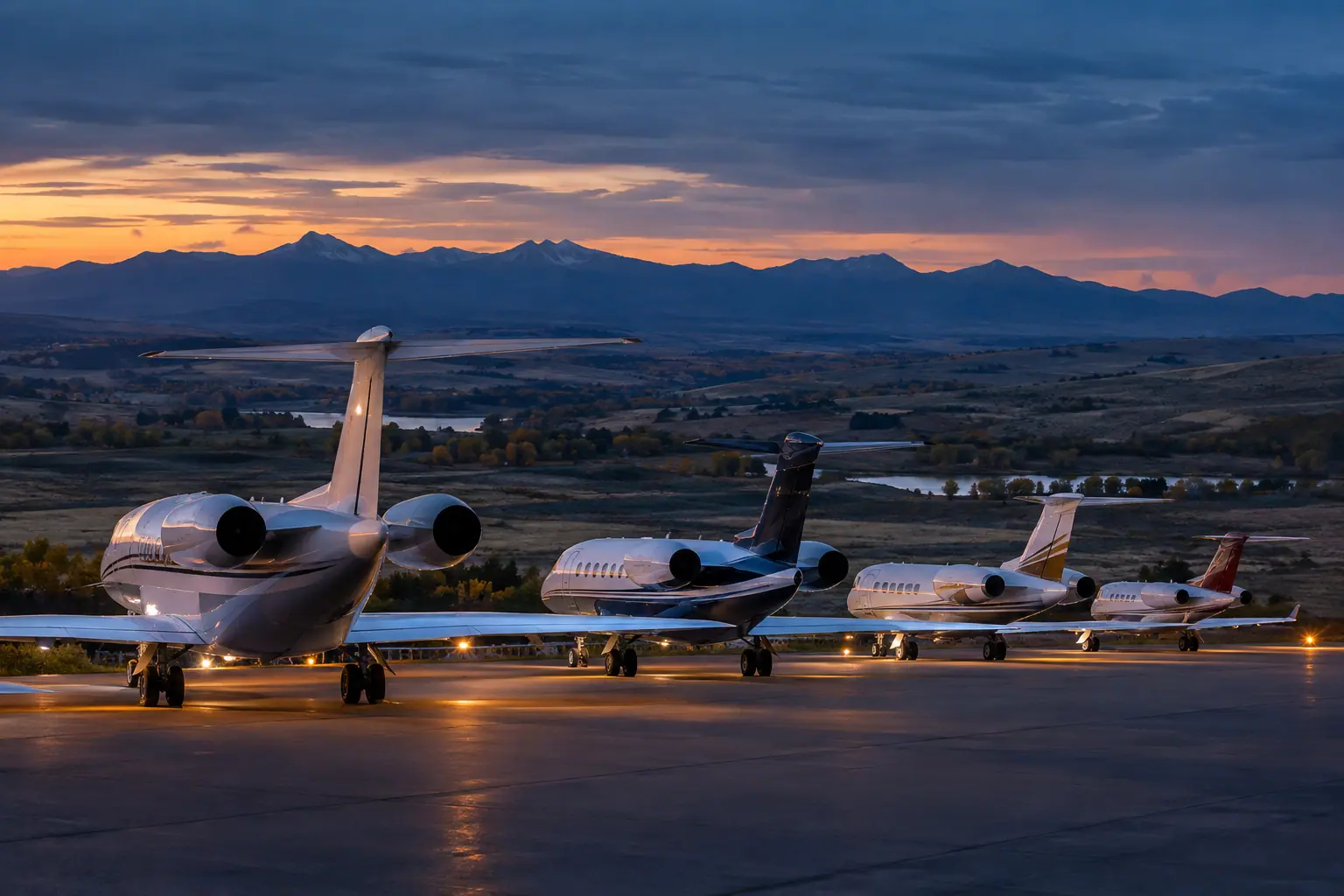
Private jet charter aircraft Denver
Choosing a private jet charter aircraft in Denver starts with runway and altitude math, not a cabin photo. Centennial sits at 5,885 ft, so summer departures trim payload more than flatland fields do. This page lays out the fleet and the trade-offs.
- Main page
- Aircraft
Denver is a hard place to launch an airplane. Every field in the metro sits above 5,400 ft, and July density altitude runs from 8,700 ft at Denver International to 9,200 ft at Centennial. On a hot afternoon a light jet that carries seven out of Phoenix may only legally carry four or five here, and a turboprop loses payload before it loses range. That is the first thing a broker checks on any Denver charter request in summer; it matters more than the leather.
The flip side is range. Denver sits far enough west that a super-midsize or heavy jet can reach either coast nonstop, while a light jet comfortably covers the mountain states and most of the Midwest. Plan on a light jet for Phoenix in 1h 32m and a midsize for the longer legs if you want a flat floor and a real baggage hold. The sections below cover each class, the airframes that actually show up on Colorado ramps, and where the money goes.
Turboprop
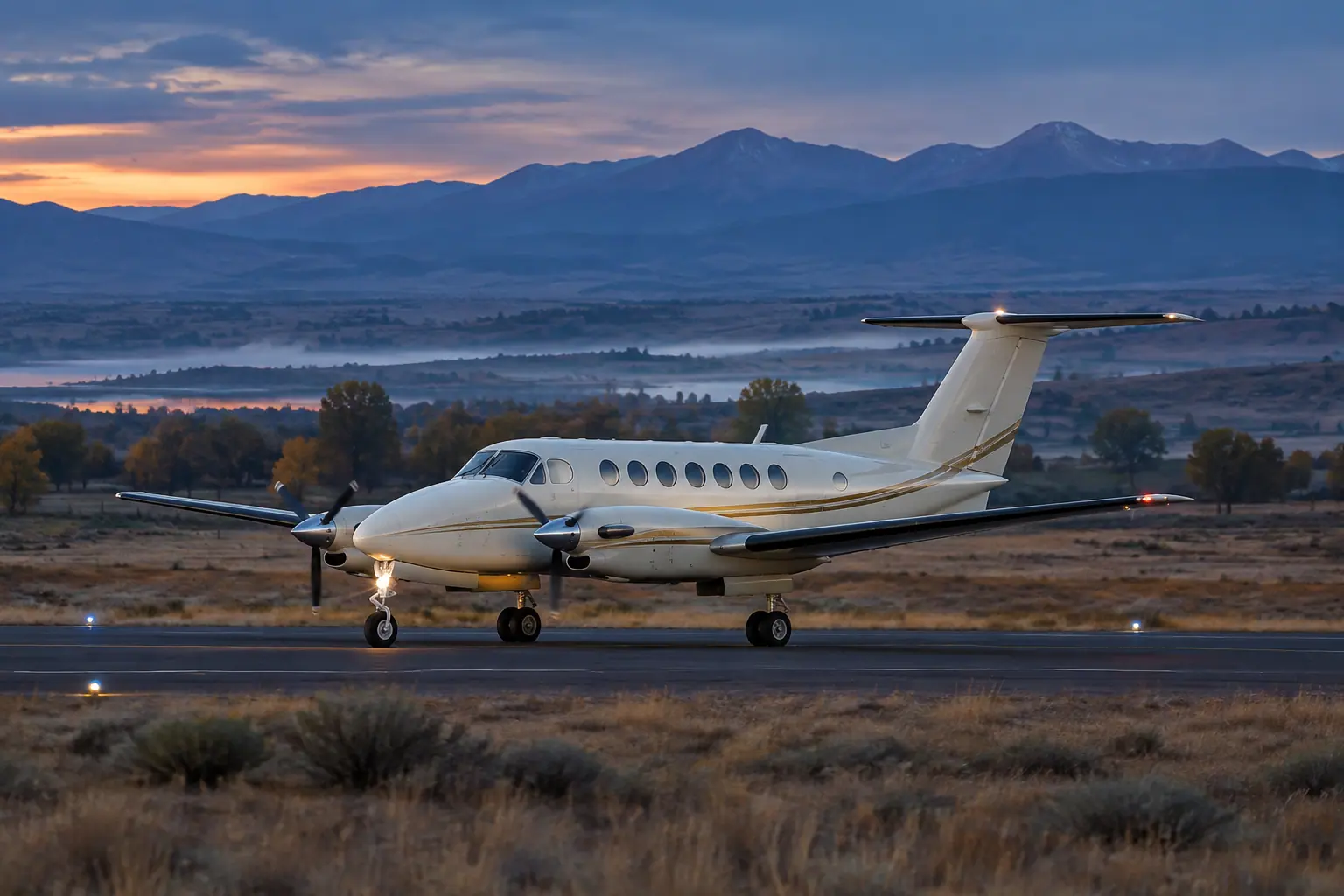
Turboprops earn their keep on short mountain-state hops and on ski trips where the runway is the constraint, not the budget. Hourly rates of $2,200 to $3,500 buy 300 kt cruise and 6 to 8 seats. A King Air 350i handles Aspen and Telluride better than most light jets because it climbs well and lands slow. Expect a prop for Vail, Gunnison, and short field work.
Beechcraft King Air 350i
- 8 seats
- 312 kt speed
- 1,800 nm legs
The King Air 350i is the most useful turboprop out of Colorado. Eight seats, 312 kt cruise, 1,800 nm of range, and 55 cu ft of baggage in a 16 ft 8 in cabin. It gets into mountain strips that a Citation cannot use, and it burns far less fuel per seat. A sensible pick for Aspen, Telluride, and short regional legs.
Pilatus PC-12 NGX
- 6 seats
- 290 kt speed
- 1,800 nm legs
The PC-12 NGX is the single-engine option: six seats, 290 kt, 1,800 nm, and a 40 cu ft baggage compartment. It is the least expensive airframe here to run on a Denver to Vail or Gunnison hop, and the cabin is quiet for its size. Good for two to four travelers who value cost over speed.
Light jet
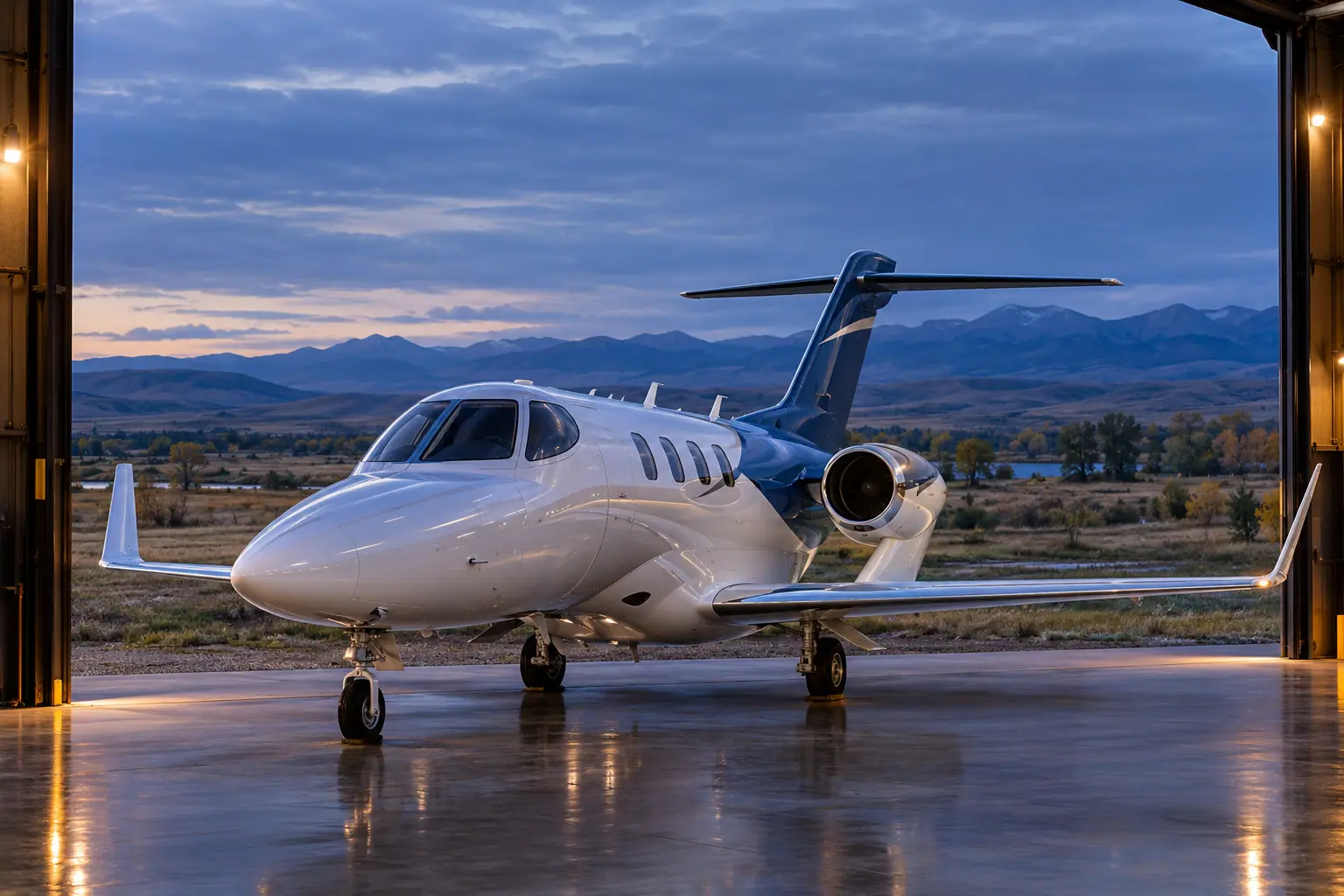
Light jets are the workhorse of Denver charter. At $3,800 to $5,800 per hour and 430 kt cruise, they cover Phoenix, Dallas, Vegas, and Los Angeles on one leg with 4 to 7 seats. A Citation CJ4 Gen2 reaches most of the West nonstop from Centennial with 2,165 nm of range. Watch payload on hot afternoons; density altitude eats into it fast.
Cessna Citation CJ4 Gen2
- 7 seats
- 451 kt speed
- 2,165 nm legs
The Citation CJ4 Gen2 seats seven, cruises at 451 kt, and carries 2,165 nm with 71 cu ft of baggage. It flies Denver to Los Angeles in about 2h 06m and still has reserves, and it is the light jet most Denver operators keep on the ramp. Payload drops in July heat; plan the bag count early.
Embraer Phenom 300E
- 7 seats
- 464 kt speed
- 2,010 nm legs
Midsize jet
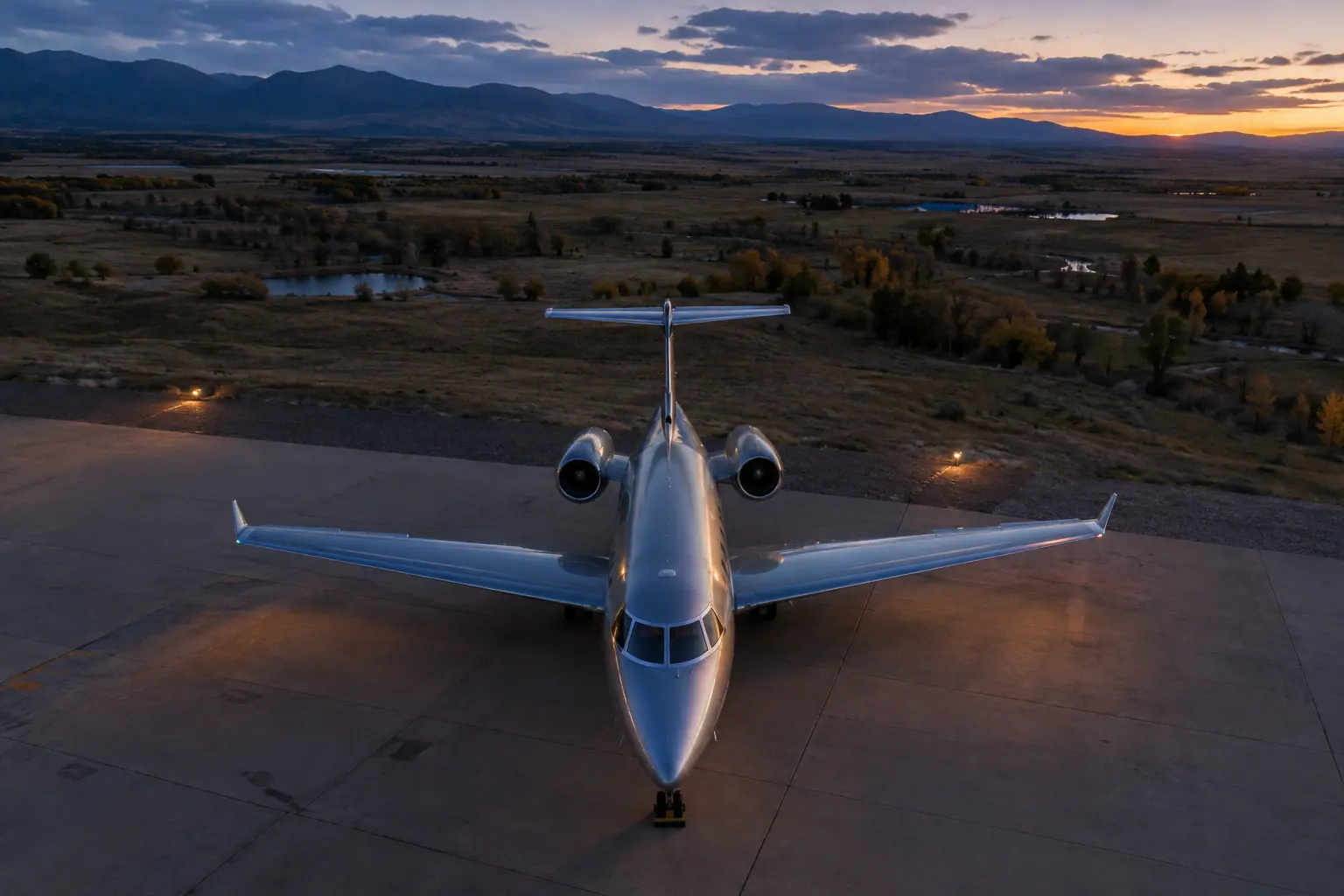
Midsize jets give you a stand-up cabin, a proper baggage hold, and the range to reach Chicago, Houston, or Atlanta without a fuel stop. Rates run $5,200 to $7,800 per hour for 7 to 9 passengers. The Citation XLS+ carries 90 cu ft of luggage, which matters on ski trips when boot bags and skis travel with the family.
Hawker 800XP
- 8 seats
- 447 kt speed
- 2,540 nm legs
The Hawker 800XP is the classic midsize: eight seats, 447 kt, 2,540 nm, and a 5 ft 9 in stand-up cabin. It is a proven, widely available airframe for Denver to Chicago or Houston and carries 50 cu ft of baggage. Older cabins vary a lot between airframes, so ask about refurbishment dates.
Cessna Citation XLS+
- 8 seats
- 441 kt speed
- 2,100 nm legs
The Citation XLS+ seats eight with a 5 ft 8 in cabin, 441 kt cruise, 2,100 nm range, and 90 cu ft of baggage. That baggage volume is the reason ski groups ask for the XLS+ out of Centennial, where boot bags and hard cases add up. A practical midsize for families and small crews.
Super-midsize jet
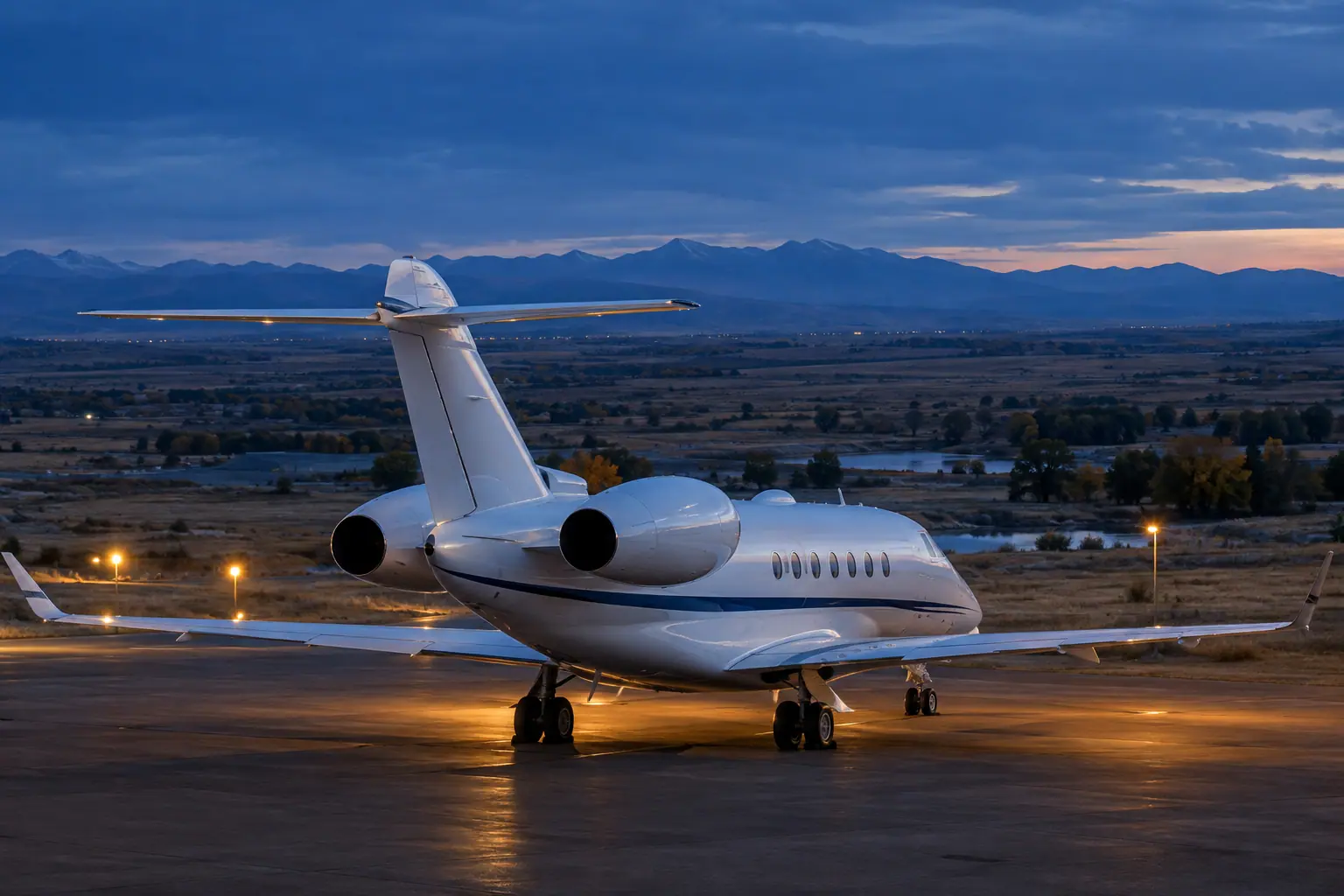
Super-midsize is the class that unlocks both coasts from Denver. At $7,200 to $10,000 per hour, 8 to 10 seats, and range past 3,200 nm, a G280 or Citation X+ flies Denver to New York or San Francisco nonstop with margin. A Citation X+ cruises at 527 kt, the fastest airframe on this page, which shortens the westbound return against the jet stream.
Gulfstream G280
- 9 seats
- 482 kt speed
- 3,600 nm legs
The G280 is the super-midsize benchmark: nine seats, 482 kt, 3,600 nm, and a 6 ft 3 in cabin with 154 cu ft of baggage. It flies Denver to New York or San Francisco nonstop with a full cabin and still lands short. The large baggage hold suits longer trips with golf or ski gear.
Cessna Citation X+
- 9 seats
- 527 kt speed
- 3,460 nm legs
The Citation X+ is the speed pick: nine seats, 527 kt cruise, 3,460 nm, and 82 cu ft of baggage. Denver to Miami runs 1,479 nm and the X+ makes short work of it westbound against the wind, which is where speed pays. Cabin height is 5 ft 8 in, so it is not a stand-up cabin.
Heavy jet
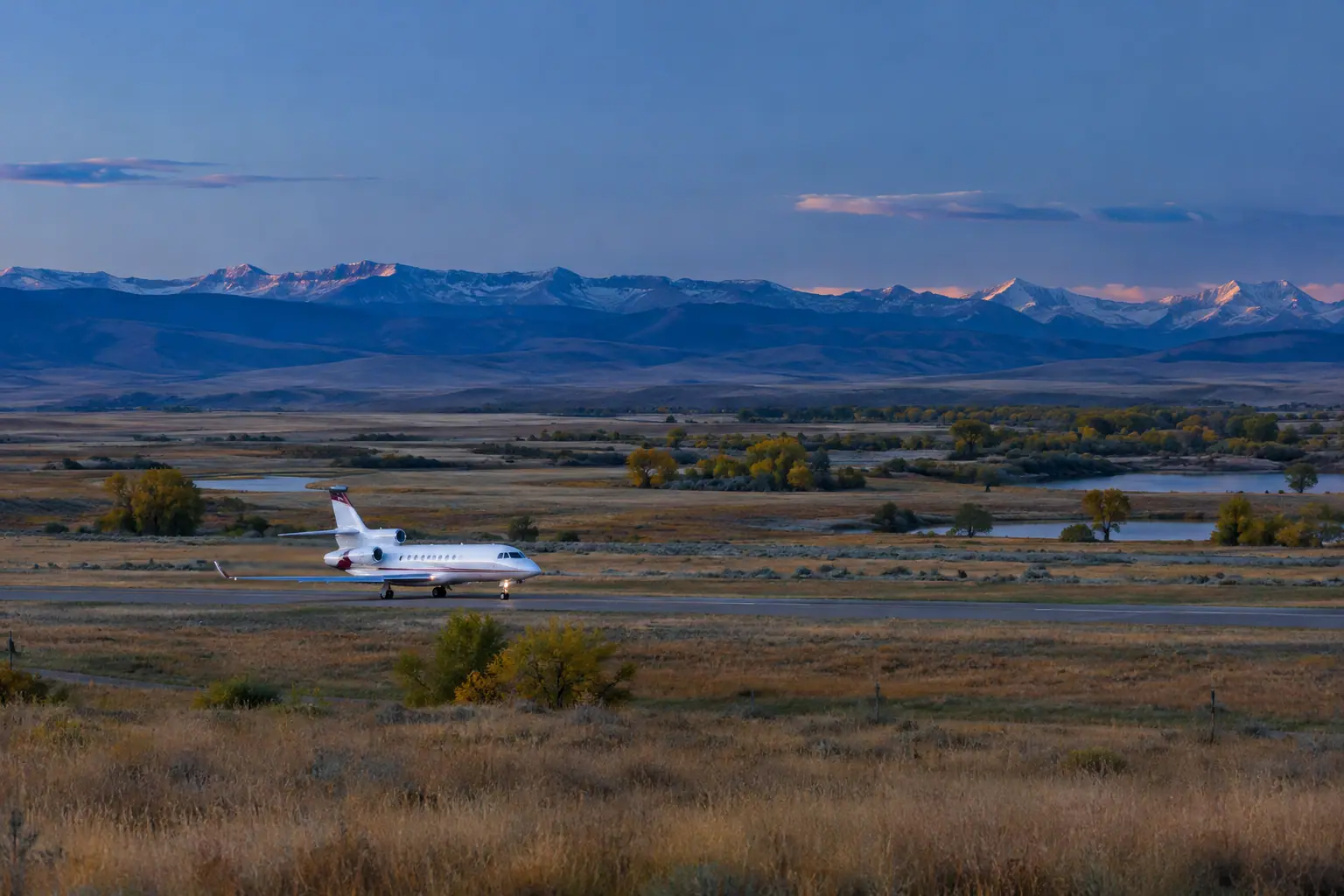
Heavy jets are for full cabins, long overwater legs, and groups that need a real galley. Rates of $9,500 to $14,500 per hour buy 10 to 14 seats and 4,000 nm or more of range. A Falcon 900LX covers Denver to Turks and Caicos without a stop at 4,750 nm, and the Challenger 650 is the standard choice for a full 12-passenger cabin to the Caribbean.
Bombardier Challenger 650
- 12 seats
- 470 kt speed
- 4,000 nm legs
The Challenger 650 carries 12 passengers at 470 kt with 4,000 nm of range and a 6 ft 2 in, 28 ft 4 in cabin. It is the standard heavy for a full cabin from Denver to the Caribbean, with 115 cu ft of baggage and a real galley. Ask about the operator's experience with mountain departures.
Dassault Falcon 900LX
- 12 seats
- 459 kt speed
- 4,750 nm legs
The Falcon 900LX seats 12, cruises at 459 kt, and reaches 4,750 nm with 127 cu ft of baggage in a 33 ft 2 in cabin. It covers Denver to Turks and Caicos, 1,975 nm, with range to spare and handles hot-and-high departures well. A three-engine airframe that many brokers reach for on long overwater legs.
Denver private jet charter aircraft
Start with the field, because it changes the airplane. Centennial is the busiest general aviation airport in the region, with three FBOs and a 10,001 ft runway, and it is the default for most Denver charters. Rocky Mountain Metropolitan in Broomfield has a 9,000 ft runway and sits closer to Boulder, so if your party is north of the city, then Rocky Mountain saves a drive across the metro.
Then match range to the leg. Denver to Phoenix is 505 nm and a light jet does it in 1h 32m; Denver to New York is 1,400 nm and wants a super-midsize or heavy if you want nonstop. When the cabin is full and the temperature is high, then expect a fuel stop on the longest legs unless the airframe has margin. Ask for the payload number, not just the range figure.
Buckley Space Force Base has the longest runway in the metro at 11,006 ft, but it is a military field and not a normal charter destination; do not plan around it. Denver International's 16,000 ft runway is the longest anywhere in the region, yet its 5,431 ft elevation still produces density altitudes near 8,700 ft in July. If you need a hot-day departure with a heavy fuel load, then a longer runway at a lower field is the lever you have.
Questions
What does private jet charter aircraft Denver cost per hour?
Hourly rates run from $2,200 to $3,500 for a turboprop, $3,800 to $5,800 for a light jet, $5,200 to $7,800 for a midsize, $7,200 to $10,000 for a super-midsize, and $9,500 to $14,500 for a heavy. These are estimates before taxes and fees, and hot-day payload limits can change which class you actually need.
How long is a private charter flight from Denver to Phoenix?
Denver to Phoenix is 505 nm and a light jet covers it in about 1h 32m, with light jet pricing estimated at $6,000 to $9,000. It is the shortest of the common Denver routes and the easiest to fill on short notice. Summer density altitude can trim seats on a light jet.
Which Denver airport do most private flights use?
Centennial Airport is the usual choice, with a 10,001 ft runway, 5,885 ft elevation, and three FBOs on the field. Rocky Mountain Metropolitan in Broomfield is the alternative at 5,673 ft with a 9,000 ft runway. Denver International handles charters too, but its 5,431 ft elevation still yields July density altitudes near 8,700 ft.
Why does altitude matter so much for a Denver departure?
Warm air at altitude thins further, so at 115F the peak density altitude reaches about 9,800 ft at Centennial and 9,200 ft at Denver International. That reduces lift and climb performance, which cuts payload or fuel. If your group is large and the day is hot, then a super-midsize or heavy jet gives you margin a light jet cannot.
How far can a private jet fly nonstop from Denver?
A super-midsize like the G280 covers 3,600 nm and a Falcon 900LX reaches 4,750 nm, so both coasts and the Caribbean are nonstop. Denver to Turks and Caicos is 1,975 nm and heavy jet territory; Denver to New York is 1,400 nm. Light jets top out around 2,165 nm in the CJ4 Gen2.
Who is responsible for the flight on a charter booking?
The operating carrier holds operational control and flies under FAA Part 135 rules; we act as your agent and arrange the trip, which is how a broker is treated under DOT Part 295. International legs add CBP clearance at both ends, and TSA rules apply to certain charter operations. Ask any broker who the operator will be before you sign.
Can I charter to Cabo San Lucas or Nassau from Denver?
Yes. Denver to Cabo San Lucas is 1,025 nm and about 2h 48m in a light jet, estimated at $10,500 to $16,500. Nassau is 1,630 nm at roughly 5h 02m, which is better suited to a midsize or larger airframe. Both are international legs, so build in time for customs.