Denver-Jackson Tops Turbli's Turbulence Ranking
The 1.7-hour flight between Denver and Jackson, Wyoming, was ranked the most turbulent route in North America in a 2025 study by aviation information company Turbli, the New York Post reported. The ranking follows a fatal Learjet crash in Palm Beach County, Florida, whose cause has not been determined.
- Nov 4, 2026Published
- nypost.comOutlet
- Main page
- Aviation news
- Denver-Jackson Tops Turbli's Turbulence Ranking
What the study found
Turbli's 2025 analysis covered 10,000 routes among 550 of the world's largest airports and scored each by eddy dissipation rate (EDR), a measure of turbulence intensity in the atmosphere. The Denver-Jackson route recorded an EDR of 18.18, which on Turbli's scale sits in the light band of 0 to 20, according to the Post. Turbli noted that yearly averages make the ranking tables look low.
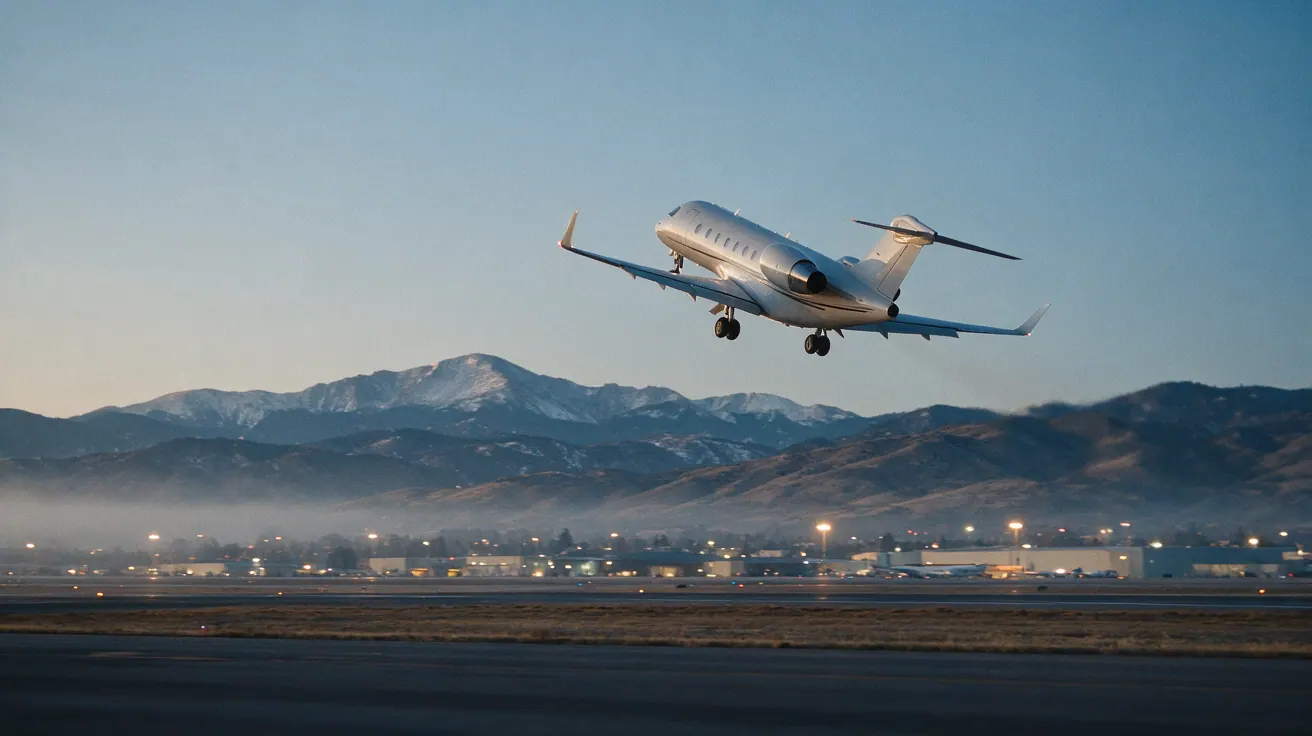
The world's most turbulent route in the same study was Mendoza, Argentina, to Santiago, Chile, at an EDR of nearly 23. Both top routes cross mountain ranges: Denver-Jackson runs through the Rocky Mountain region, and Mendoza-Santiago crosses the Andes. The Post also reported comments from University of Reading atmospheric science professor Paul Williams, who said turbulence is increasing, citing research showing 55% more over the North Atlantic than in the 1970s and 44% more above America.
The Denver side of the story
For anyone picking an airport on the Front Range, the practical detail is that this is a route in our own backyard. Centennial Airport (KAPA) has a 10,001-foot longest runway and FBOs including jetCenters of Colorado, Modern Aviation and Signature Aviation - North. Rocky Mountain Metropolitan Airport (KBJC) offers a 9,000-foot runway with Signature Aviation, Sheltair and Signature Aviation - North on field. Denver International (KDEN) has a 16,000-foot runway but no FBOs listed on our site, so charter departures in the metro tend to route through KAPA or KBJC.
Denver's registry counts 261 jets based in Colorado, 45 of them local, with the Dassault Falcon 2000 (6), Cirrus Vision Jet (5) and Gulfstream IV/G450 (4) among the most common local models. For a short mountain leg, the aircraft class is worth weighing openly: posted hourly rates run $3,800 to $5,800 for light jets, $5,200 to $7,800 for midsize, $7,200 to $10,000 for super-midsize and $9,500 to $14,500 for heavy jets, with turboprops at $2,200 to $3,500. We arrange charter with Part 135 operators; the choice of class, and what a passenger prefers in rough air, is a conversation between client and operator.
Context beyond the Rockies
The Post tied the turbulence discussion to Sunday's Learjet crash in Palm Beach County, Florida, which killed all nine people on board. The intended route was Austin-Bergstrom International to North Eleuthera Airport in the Bahamas, and the cause has not been officially determined. The co-pilot, 20-year-old Nathalia Gadelha Filgueiras, texted her boyfriend about 10 minutes before the crash saying she had turbulence and ice, according to her stepfather, Thiago Corleti, as quoted by the Post.
Austin appears on our route list as well: Austin to Denver runs 668 nautical miles with a light jet listed as the best fit at $7,500 to $11,000. Other Denver routes we quote include Dallas at 562 nm with light jets from $6,500 to $9,500, Phoenix at 505 nm from $6,000 to $9,000, and Chicago at 782 nm from $8,500 to $13,000. Longer hauls shift to midsize: Miami to Denver at 1,479 nm runs $20,000 to $30,000, and New York to Denver at 1,400 nm runs $19,000 to $28,500.
When Denver traffic peaks
Season matters for scheduling on any of these legs. Our Denver search data puts the peak month at February and the low month at September, which is worth knowing when comparing quotes for winter mountain departures against early-fall dates.
None of this changes the fundamentals of mountain flying: terrain and eddies are a planning input, not a verdict. The Turbli figures are yearly averages for the route, and the Post's reporting on rising turbulence reflects atmospheric research rather than any single flight. Passengers with questions about a specific leg should raise them with the operator flying it.
Drawn from nypost.com coverage: Most turbulent flight in the US is less than 2 hours long across deadly terrain.
How this affects your plans
- Turbli's 2025 study ranked Denver-Jackson (1.7 hours) the most turbulent route in North America at an EDR of 18.18, per the New York Post.
- Both top-ranked routes cross mountain ranges; the Post reports 44% more turbulence above America than in the 1970s.
- Centennial (10,001-ft runway) and Rocky Mountain Metro (9,000 ft) both list FBOs; KDEN shows no FBOs on our site.
- Colorado registers 261 jets, 45 local, and our Denver season peaks in February with September the low month.